 |
Coins of Ancient Greece - page 2Asia and Africa.
|
|---|
|
Coins of Ancient Greece - page 2Asia and Africa.
|
|---|
|
IMAGE
|
DESCRIPTION
|
REFERENCE
|

|
Kyzicus,
Mysia, AR Trihemiobol 480 - 450 BC Obv: Forepart of crested boar left. Tunny fish upward behind. Rev: Lion head left, in incuse square. |
Sear 3848 |

|
Kyzicus, Mysia, AR obol 480 - 450 BCE (0.71 gm) Similar to above: K in field above lion. |
Sear 3848 |

|
Kyzicus, Mysia, Circa 390-341/0 BC. AR Tetradrachm (13.67 gm) obv: Wreathed head of Kore Soteira left, hair in sphendone covered with veil. rev: Head of lion left; below, tunny fish left; pilos to right(?); KY visible above forehead Ex: Robinson Auction |
Von Fritze II, 23; Pixodarus Type 2, -; SNG France -. |

|
Amisos Pontos 120-63 BCE Obv: Supposed faint Head of Medusa in center of Aegis. Rev: Nike carrying wreath and palm: AMI-SOY. |
Sear 3642 |

|
Amisos Pontos Circa 4th Century BCE. AR Siglos (18mm, 3.26 g) Obv: Head of Hera left, wearing stephane. Rev:Facing owl; LI-IS on either side. Ex: CNG Electronic Auction |
SNG BM Black Sea 1053; cf. SNG Stancomb 658 |

|
Amisos Pontos Circa 125-100 BCE. AE (20mm, 8.35 g) Obv: Bust of Artemis right. Rev:AMI-?OY, tripod. Ex: ? |
SNG BM Black Sea 1139. |

|
Paphlagonia, Sinope AR Drachm, 5.56 gm. Obv: Head of nymph Sinope left, hair bound in a saccos; aplustre before. Rev: Sea eagle l. on dolphin; magistrate IKE_; SIN below. Ex: Frank Robinson |
Sear Greek 3696 |

|
Paphlagonia, Sinope Circa 85-65 BC. Æ (31mm, 18.96 g, 12h). Obv: Helmeted head of Athena right. Rev: Perseus standing, facing, holding harpa and head of Medusa, whose decapitated body lies at his feet; ?M monogram to left.. Ex: CNG auction 274, Lot 138 |
SNG BM Black Sea -; SNG Stancomb -; RG 62. |

|
Greek Kyme, after 190 B.C. AR Tetradrachm 16.95 gm. Obv: Head of the Amazon Kyme right wearing taenia . Rev: Horse standing right, one handled cup below; KALLIAS magistrate. Ex: Pars Coins A beautifully rendered work of art. While much of the art seen on coins had declined from its high point in the Classical era, cities in western Asia Minor experienced a renaissance of the celators' art in the period between Seleukid and Roman rule (see Myrina below). |
Oakley, ANS MN 27, issue 16 |

|
Aeolis, Myrina.
After 165 BC. AR Tetradrachm (16.57 gm). Obv: Laureate head of Apollo right. Rev: Apollo Grynios holding branch and phiale, omphalos and amphora at feet; monograms to left. ex: Frank Robinson |
ANS MN 30 |

|
Troas, Antandros.
Circa 4th-3rd Century BC ®12 Obv: Laureate head of Apollo right. Rev: lion's head right. ex: Mediterranean Coins |
SNG von Aulock 1493 |

|
Parion, Mysia, 3/4 drachm, gorgon @480 BCE (3.12 gm) Obv: Facing gorgon head, with tongue protruding. Rev: Incuse square containing cruciform pattern with pellet at center. ex: F. Robinson |
Sear 3917 |

|
Mysia,
Pergamon. Circa 76-67 BC. AR Cistophoric Tetradrachm (12.58
gm) Obv: Cista mystica with serpent; all within ivy wreath. Rev: Bow-case with serpents; ethnic monogram left, KT and monogram above, thyrsos right. |
Sear 3948v |

|
Pergamene Kingdom, Eumenes or Attalus I. 263-241 BC or 241-197.
Silver tetradrachm (16.95 gm) Obv: Laureate head of Philetaerus right. Rev: Athena enthroned left, crowning royal name with right hand and resting left elbow on round shield propped against throne, transverse spear in background, cornucopiae in outer left field, EYMENOY monogram in inner left field, bow in outer right field. |
SNG Paris 1622 |

|
Achemenid [Persian] Empire 400 - 330 BCE AR Siglos (6.47 gm) Obv: King advancing left with bow and spear. Rx: Incuse punch. ex: F. Robinson |
Sear 4682 |

|
Achemenid
[Persian] Empire 400 - 330 BCE AR Siglos (5.49 gm) Obv: King advancing left with bow and dagger. Rx: Incuse punch. ex: F. Robinson |
Sear 468o |

|
Cappadocian
Kingdom. Ariobarzanes I Philoromaios, 96-63 BC. Dated RY 22
AR Drachm(4.07 gm) Obv: His Diademed head right, bearded. Rx: Athena Nikephoros standing left holding Nike in right hand, spear and shield; in inner left field, monogram, KA (date) in exergue. ex: ? |
Simonetta, Coins 28 |

|
Cappadocian
Kingdom. Ariobarzanes III, 52-42 BCE, AR Drachm (3.68 gm) Obv: His laureate head right, bearded. Rx: Athena standing left, holding Nike right, spear and shield; in field to left, star and crescent. ex: Mediterranean Coins |
BMC 42, 3 |

|
Alexander III, the Great (336Ð323 BC). AR tetradrachm (16.59
gm). Posthumous issue of Temnos, ca. 188 - 170 BC. Obv: Head of young Heracles right, wearing lion-skin headdress. Rx: ALEXANDROU, Zeus seated left, holding eagle in right hand and scepter in left, two monograms in left field, oinochoe in oak wreath in lower left field. |
Sear 1688 |

|
Ionia, Miletos 6th
century BCE 1/12 Stater (0.91 gm) Obv: Lion's head left. Rx: Flower pattern. 9 mm! Tell me they did not have magnifiers to engrave this little beauty. Ex F. Robinson. |
Sear 3532 |

|
Ionia, Miletos after 190
BC Octobol (18 mm 4.95 gm) Obv: Laureate head of Apollo right. Rx: Lion standing right, looking back at 8-rayed star. Probably represent the alignment of the sun or Venus in the constellation Leo. (Rare denomination) Ex Ancient Imports. |
BMC 115v, Sear 1674 |

|
IONIA, Ephesos
Circa 387-295 BC. AR Tetradrachm (14.94 gm) Obv: E-F, bee with straight wings. Rev: Forepart of a stag right, palm tree left; magistrate MANTIKRATH[S]. Site of the Temple of Artemis, one of the 7 Wonders of the world. Ex CNG 61, Lot: 683. |
Head pg. 35; SNG Copenhagen 229 |

|
Ionia, Ephesos; AR Drachm Obv: Bee. Rev: Stag facing right, Palm Tree behind, magistrate's name to right. Ex Bassem |
BMC 14, 61 123; Sear 4387 |

|
Ionia, Ephesos; AR Cistophoric Tetradrachm. Struck 189-133 BCE Obv: Cista Mystica containing serpent, all within ivy wreath. Rev: Bow in case between two twined serpents. E?E left. Ex Jonathan Kern |
SNG Copenhagen 326 (var). |

|
Ionia, Herakleia ad Latmon. Circa 165-140 BC. AR Tetradrachm
(16.70 g, 1h) Obv: Helmeted head of Athena right. Rev: Club; below, two monograms flanking Nike advancing left; all within oak wreath. Ex: John F. Sullivan Collection; Sale: CNG 70, Lot: 249 |
SNG Copenhagen 781 var. (monograms); BMC Ionia 1 var. (same); SNG von Aulock 1978 var. (same) |

|
Ionia, Miletos Helmet detail from coin above. |
Sear 3532 |

|
Ionia, Smyrna. Circa 145-125 B.C. ® 21mm/ Homereion (8.61 gm).
Appidaiosmon, Magistrate. Obv: Laureate head of Apollo right. Rev: the poet Homer seated left, holding staff and scroll. Ex Tom Vossen |
Milne 182 |

|
Ionia, Teos,320 - 294 BCE AR diobol (7mm, 0.92g) Obv: Griffin right with forepaw raised. Rev: Chelys lyre. Ex Numis Coins |
SNG Kayhew 610 |

|
Ionia, Teos, AR tetartemorion = 1/4 obol, (7mm, 0.20g) c.
478-449 BCE Obv: Griffin head. Rev: Quadripartite incuse square. Ex Mediterranean Coins |
Klein 481 |

|
Caria, Satraps, Maussollos 377-353 BC. AR Drachm (3.57 gm). Obv: Laureate head of Apollo, facing slightly right Rev: Zeus Labraundos standing right, holding double axe (labrys) and lotus-tipped sceptre Famous builder of the Maussoleum, one of the 7 wonders of the world. Ex Frank Robinson |
Sear 4956 |

|
Caria - Helicarnassus; Hemi-obol, @ 380BCE (0.40 gm) Obv: Ram's head right. Rev: Young male head right Besides being the birthplace of Herodotus, Helicarnassus was the site of the Mausoleum Ex Harlan Berk |
SNG Keckman - 883 |

|
Caria - Caunus; hemidrachm, after 168 BCE (1.04 gm) Obv: Hd. of Athena right. Rev: Sword in sheath, with strap; Bucranium to left; KTH(?) above, K to left, X to right. Ex Dr. Henry C. Lindgren |
Sear 4818 |

|
Caria - uncertain Dynasts; hemidrachm, 5th cent. BCE (2.45 gm) Obv: Winged half-kneeling figure right. Rev: Griffin stdg. right paw raised, |
von Aulock 2352 and 8059 - rare |

|
Caria, uncertain, first half 4th century BC, AR Persic Hemiobol
(0.31 gm.) 7.51 mm. Obv: young male head right; Karian inscription. Rev: Sheep's head right. A miniature masterpiece! a page demonstrating the size of this little gem. Ex: Tom Vossen |
SNG Helsinki I, 883 |

|
Caria
- Rhodes Didrachm; 304 - 166 BCE (6.49 gm) Obv: Head of Helios 3/4 profile Rev: Rose 1/2 opened; Grain ear left: Bud right Ex H. C. Lindgren Some suggest the image of Helios is the face of the Colossus of Rhodes - Another of the 7 Wonders of the Ancient World. |
Sear 5048 |

|
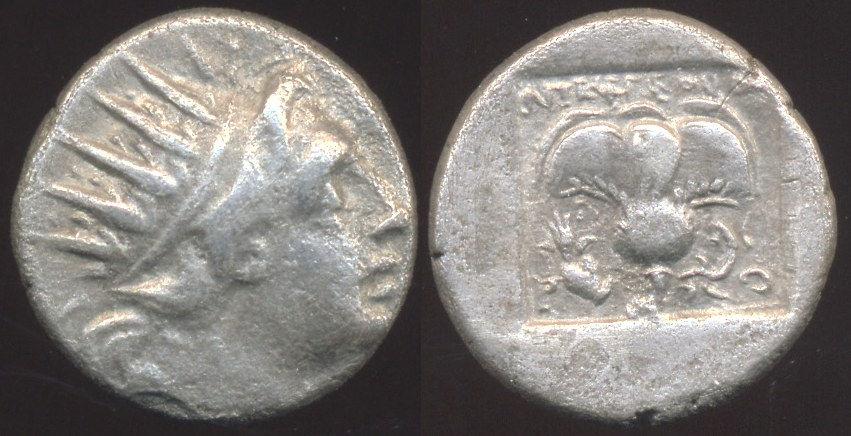
ISLANDS off CARIA. Rhodes. Circa 166-88 BC ®12; (1.39 gm) Obv: radiate head of Apollo right. Rev: Rose. Ex: Mediterranean Coins |
SNG Copenhagen 860 (variant - this rose not in incuse square. |
|
ISLANDS off CARIA. Rhodes. Circa 88 BC Æ12; (2.27 gm)
Nikephoros, magistrate. Obv: radiate head of Apollo right. Rev: Rose with bud to right; hand holding grain-ear to left; NIKFOROS above |
Jenkins, Rhodian Group E, 249; SNG Copenhagen 824 |

|
Lycia, Masikytes. AR Diobol; (.73 gm) 1st century BCE. Obv: Bust of Artemis right; Bow and quiver berhind. Rev: Quiver w/ M/A |
cf. SG.5300 |

|
Pamphylia,
Aspendos. Circa 370-330 BC. AR Stater (10.45 gm) Obv: Two wrestlers grappling; KI between. [E]STFEDIIU[S], slinger to right, shot bag on hip; triskeles in field Ex: Jeff Gorman Turkey is still a world power in wrestling. This coin from southern Turkey illustrates just how far back that heritage goes. In a similar fashion to Rhodes chosing a rose for the reverse symbol on their coins, It has been suggested that the slinger was chosen for the similarity of the Greek word for sling, sphendone, to the name of the town. These coins are slightly larger than Greek staters as they were struck on the Persian weight standard. |
SNG von Aulock 4557; SNG France 104. |

|
Pamphylia, Side. Circa 155-36 BC. AR Tetradrachm (16.20 gm)
Kleuch-, magistrate Obv: Helmeted head of Athena right. Nike advancing left, holding wreath and palm; pomegranate to left, KLE-YX across field Ex: Numis Coins The style of the Side coins from this era was usually not at the level of the Ionian cities of this time. This coin's obverse is of relatively nice style while the reverse is quite crude. |
SNG France 697. |

|
Alexander III. 336-323 BC. AR Tetradrachm (16.96 gm). Perga
mint. Year 26 (196/195 BC). Obv: Head of Herakles right, wearing lion's skin headdress Rev: Zeus seated left, holding eagle and sceptre; KC left Ex: American Coins |
Price 2940; M?ller 1242 |

|
Cilicia, Tarsos, Datames, 378-362 BC, AR Stater (9.98 gm.),
23.22 mm. Obv: female head (Arethusa ?) with sphendone and necklace facing Rev: helmeted head of bearded male right. Ex: Tom Vossen |
BMC 167; SNG Levante 78 |

|
Cilicia, Tarsos, Mazaios, Satrap 361-334 BC, AR Stater (10.61
gm.) Obv: Baaltars seated left; holding sceptre, corn-ear, bunch of grapes and eagle. Aramaic characters on either side and beneath throne Rev: Lion bringing down bull; MZDI in Aramaic above Ex: Eukratides |
BMC Cilicia, pg. 171, 52 |

|
Soloi, Cilicia ® 21 c. 200 BCE Obv: Artemis rt, wearing spephane, bow and quiver at neck. Rev: Athena advancing rt brandishing thunderbolt & holding shield, PE to left |
Sear 5621 var. |
|
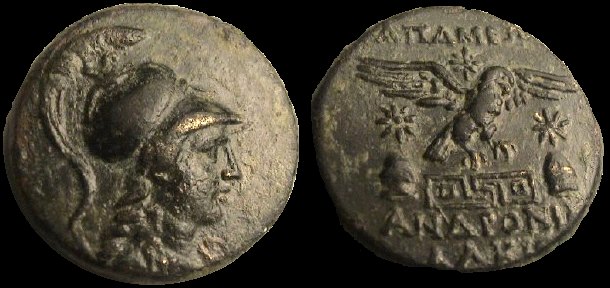
Phrygia, Apameia, 133-48 BC; ® 21; (7.83 gm.) Obv: Head of Athena right. Rev: Eagle flying r. over meander symbol, star and ethnic above; at sides, star atop pileus; magistrate's name below. Ex. Mediterranean Coins |
SNG Cop-161-9 |
Phoenicia |
||

|
Phoenicia, Arados. Cira 350-332 BC. Heavy Stater 8.80 gms. Obv.: Laureate head of marine deity right. Rev: Galley right with helmsman and 12 oarsman Ex. Wayne Phillips Coins |
BMC 72 |

|
PHOENICIA,
Sidon: King 'Abd'Ashtart II, 345-343/2 BCE. AR dishekel
(octodrachm), 24.99 gm. Obv.: War galley w/ 15 oarsman left; Star above stern. Rev: Chariot drawn by pacing horses left; driver leans forward holding reins; King of Persia in chariot; king of Sidon in Asian-style costume carrying cultic scepter and votive vase following; double Phoenician "Ayin" in upper left field. Ex. Eukratides |
Sear 5942, Betlyon, ANSMN 21, 33; plate VI, 33a, b. |

|
Phoenicia, Tyre. Cira 400-360 BC. AR Stater 8.80 gms. Obv.: Melqart riding hippocamp right, holding reins in right hand, bow in left; double line of waves and a dolphin below Rev: Owl standing right, crook and flail over left shoulder Ex. Ofeke coins |
BMC Phoenicia p. 230, 19 |
Seleukid Empire |
||

|
Seleukid, Seleukos II Kallinikosr drachm, 246 - 226 BC Obv: Helmeted Head of Athena right. Rev: Very naked Apollo standing left, holding arrow, leaning on bow, monograms to each side. |
Sear 6900v. |

|
Seleukid, Antiochus III ®18, 222- 187 BC Obv: Laureated Head of Antiochus right. Rev: Apollo on omphalus holding bowv, testing arrow. |
Spaer 73 (different monogram) |

|
Seleukid, Alexander I Balas ®18, 150- 145 BC Obv: Helmeted Head of Alexander right. Rev: Nike left, ear of grain in left field. |
SNG Cop 263. |

|
Antiochus VI, 145-142 BC, ®23 serrate, (8.11g) Obv: Radiate head of Antiochus as Dionysos right, wreathed with ivy. Rev: BASILEWS ANTIOXOY SEB EPIPHANOYS DIONYSOY - Elephant advancing left. |
Sear 7081. |

|
SELEUKID KINGS of SYRIA. Tryphon. 142-138 BC. ® 18 5.47 gms. Obv: Diademed head right. Rev: Macedonian helmet adorned with ibex horn; monogram in inner left; caps of Dioskouroi in lower inner right field. Ex: Frank Robinson 7/05 |
SNG Spaer 1827. |

|
Seleucid Kingdom, Antiochus VII [Euergetes] 138 - 129 BCE,
AR Tetradrachm, 16.47g. Obv: Head of emperor right, wearing a fillet. Rev: Athena standing left, holding Nike in right hand, spear with left arm and resting right hand on shield; monogram and A left, O inside inscription, and A at right. BASILEWS ANTIOXOY right, EUERGETOY left One of the few bright spots among a long line of bizarre Seleukid rulers. The younger brother of Denetrios II, he deposed the usurper Tryphon [who minted beautiful coins] and ruled with wisdom and integrity until killed in battle against the Parthians [who had captured his brother 9 years earlier]. |
SNG Spaer 1873 |

|
Seleucid Kingdom, Antiochus VII [Euergetes] 138 - 129 BCE,
AR Tetradrachm, Obv: Head of emperor right. Rev: Eagle standing l. on beak of galley, palm-branch in backround; in field to left, monogram above club; to right, K monogram above Seleucid date; between eagle's legs, monogram Tyre Mint. |
Sear 7094 |

|
Seleucid Kingdom, Demetrios II. Second Reign, 130-125 BC. AR
Tetradrachm (13.65 gm). Obv: Diademed Head of emperor right. Rev: Eagle standing l. on beak of galley, palm-branch in backround; in field to left, monogram above club; to right, K monogram above Seleucid date; between eagle's legs, monogram Eagle standing left on prow, palm over shoulder, club left surmounted by TYP monogram; APE left, AS and delta PR right, Z_ between legs Tyre Mint. |
Sear 7105v |

|
Seleucid Kingdom, Antiochus VIII [Grypos] First Reign. 121-113
BCE, AR Tetradrachm, 16.54g. Obv: Head of emperor right, wearing a Diadem. Rev: Zeus Oranios standing left, holding star and sceptre; IE/A to left, N to right. BASILEWS ANTIOXOY right. Antioch mint In contrast to Antiochos VII, Antiochos VIII paved the way for the end of the Seleukid empire. He participated in incessant warfare with his half-brother Antiochos IX and poisoned his mother Cleopatra in retaliation for her attempt to poison him. In keeping with the soap opera, He was murdered in 96 BCE and Antiochos IX was murdered the following year by his nephew Seleukos VI who was subsequently driven out of Antioch by his cousin Antiochos X etc. etc . EX CNG SALE 60 |
SNG Spaer 2495; Newell, SMA, 367; Houghton, CSE, 322 |

|
Philip I, Philadelphus, 93-83 BCE AR tetradrachm (15.20 gm) Obv: Diademed head of Philip II right, fillet border. Rev: Zeus seated left, holding Nike and scepter. Antioch Mint reference - Sear 7214. Minted postumously after Syria became a Roman province. |
? |
Baktria |
||

|
Baktria, Apollodotus
I 160-150 B.C. AR drachm (2.20 gm) Obv: Elephant with Greek inscription around. Rev: Humpaback bull with legends around. Mint: Taxila A fine example of the merger of Greek and Indian cultures. The square coins were probably issued to align with the square punchmark coins already in use in the region. This would also explain the animal figures that appear on many of these coins. The coin is also bilingual. The obverse is in Greek, while the reverse is Prakrit, written in Kharoshthi script which reads Maharajasa tratarasa Apaladatasa [of the king, saviour, Apollodotus]. |
Sear 7591 |

|
Baktrian Kingdom, Menander, 160-145 BC, AR Indo-Greek standard
drachm (2.43 gm) Obv: Greek legend, BASILEWS SWTHROS [MENANDROY] Diademed and draped heroic bust left, holding spear. Rev: Karosthi legend. Athena advancing right, with thunderbolt and shield. Menander is one of the more interesting personalities of ancient history. He began his rule in the southern area of Baktria and greatly expanded Baktrian rule into India. However, he was also a philospher who converted to Buddhism and subsequently ceded all conquered land back to Indian rulers. He is the only person of Greek origin who is celebrated in ancient Indian literature. He is known as `Milinda' and was a well thought of teacher and scholar. We could use more of his kind today. |
Sear 7604 |

|
Menander, Baktria 160-145 BCE, AR drachm 2.43 gms. Obv: laureate and draped bust right. Rev: Athena stg. lt. holding shield and throwing lightning bolt; Karosthi legend aoround; monogram in rt field. |
Sear 7600 |

|
Menander, Baktria square ® 20 160-145 BCE Obv: Helmeted bust of Athena right. Rev: Nike stg. rt. holding wreath and palm; Karosthi legend aoround; monogram in rt field. |
Sear 7612 |

|
Baktria, Hermaios 40 - 1 BCE Drachm (1.92 gm) Obv: Diademed bust right. Rev: Zeus seated left, Karosthi legend around; Maharajasa tratarasa Heramayasa, monogram to left. br>The last of the kings of Baktria. With his defeat by the Kushans, The independent Greek states established by Alexander ceased to exist. |
Sear 7738 |

|
Kushans, Vima Taktu - Soter Megas AD 78-110) ® tetradrachm Taxila series. Obv: Diademed, radiate bust r., holding scepter; tamgah behind. 6 rays above head. Rev: Greek inscription. Mounted horseman holding whip, adv rt., tamgah in front. |
Mitchiner ACW.2953-2956 |
Egypt/Africa |
||

|
Alexander
III (the Great) Tetradrachm Memphis mint @310 BCE Obv: Herakles in lion skin right Rev: Zeus entroned w/ eagle. Pegasos flying right in left field. |
BMC 3974b |

|
Egypt, Ptolemy II, Philadelphos. 285-246 BC. AR Tetradrachm
(25mm, 14.19 g, 12h) Sidon mint. Dated RY 36 (250/49 BC). Obv: Diademed head of Ptolemy I right, wearing aegis around neck. Rev: Eagle standing left on thunderbolt; to left, ? I above ? I; ?? (dae) to right. thunderbolt; cornucopiae before, monogram (Chi-Rho) between legs. Ex: CNG 90 |
Svoronos 749; SNG Copenhagen 516; Noeske 105 var. (date) |

|
Egypt, Ptolemy II, Philadelphos. 285-246 BC. AR Tetradrachm
(25mm, 14.02 g, 12h) Sidon mint Dated RY 32 (254/3 BC). Obv: Diademed head of Ptolemy I right, wearing aegis around neck. Rev: Eagle standing left on thunderbolt; to left, ? I above monogram; ?B (date) to right. |
Svoronos 739; SNG Copenhagen 514 |

|
Egypt, Ptolemy III, 246-221 BC. ® 34mm (33.28 gm). Obv: Diademed head of Zeus-Ammon right Rev: BASILEWS PTOLEMAIOU, eagle standing left on winged thunderbolt; cornucopiae before, monogram (Chi-Rho) between legs. |
Svoronos 965; SNG Copenhagen 173ffb |

|
Egypt, Ptolemy
VIII 145 - 116 BCE ® 25 Obv: Zeus right. Rev: Eagle left; Inscription to right. |
SNG 660v |

|
Numidian Kings. Micipsa. Circa 148-118 BC. ® 26.5 mm (11.49 gm).
Obv: Laureate and bearded head left. Horse galloping left; pellet below. Ex: Tom Vossen |
SNG Copenhagen 508. |

|
Carthage, Zeugitania 310 - 280 BCE ® 20 Obv: Head of Tanit left. Rev: Horse standing right; palm behind. Ex John Jencek |
SNG Cop 109 |

